Appifex vs Lovable vs Bolt: Which AI App Builder Actually Ships to Production?
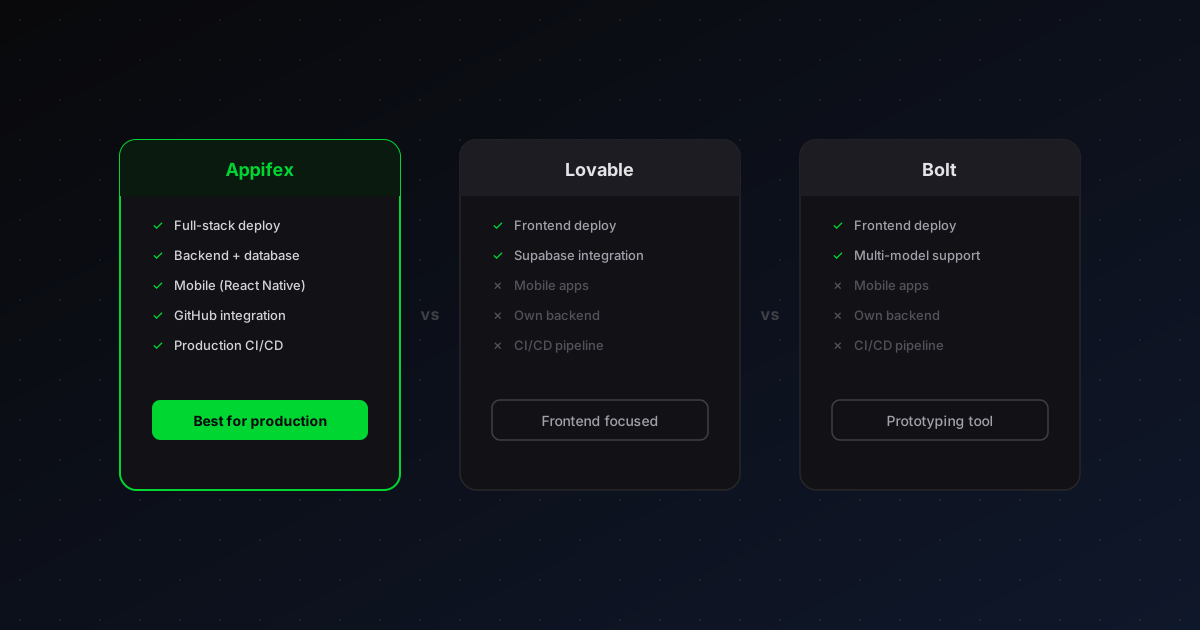
The best AI app builder in 2026 depends on what you're building. Appifex is the strongest choice for full-stack production apps with native mobile and a dedicated Python backend. Lovable works well for web apps with Supabase. Bolt is fastest for getting a working prototype up quickly. Here's the detailed breakdown.
All three tools have grown fast. Bolt added databases, auth, and deployment in 2025. Lovable shipped Agent Mode with automated error recovery and two-way GitHub sync. The gap has narrowed on basic features, but the differences in architecture, mobile support, and production workflows still matter.
I've used all three. This is an honest comparison based on what each tool actually does today.
Key Takeaways
- Appifex is the only tool that generates native mobile apps (React Native + Swift) alongside web and a dedicated Python backend, all in one monorepo
- Lovable is strongest for web apps that fit the Supabase model, with polished UI and good auth/database integration
- Bolt has caught up on basics (database, auth, deployment) but still lacks native mobile and custom backend logic
- All three offer free tiers and GitHub integration; the differences are in architecture, not surface features
- If you need a production app with a real Python backend, native mobile, and guided App Store submission, Appifex is the only option
Appifex vs Lovable vs Bolt: Feature Comparison
All three tools can generate a web app with a database and deploy it. The real differences are in what kind of backend, how mobile works, and what the production workflow looks like.
| Feature | Appifex | Lovable | Bolt |
|---|---|---|---|
| Web apps | React + Vite + TypeScript | React + Vite | React (StackBlitz/Next.js) |
| Native mobile apps | React Native + Expo (iOS & Android) | No (responsive web only) | Expo support (limited guidance) |
| Apple native (Swift) | SwiftUI (Pro tier) | No | No |
| Backend | FastAPI + SQLAlchemy + Alembic (dedicated Python backend) | Supabase Edge Functions | Node.js + Express + Server Functions |
| Database | PostgreSQL (auto-provisioned, branch isolation) | Supabase PostgreSQL (auto-provisioned) | Bolt Database (PostgreSQL) or Supabase |
| Authentication | Neon Auth (auto-scaffolded) | Supabase Auth | Bolt Auth + Google SSO |
| Payments | Stripe + RevenueCat (auto-scaffolded) | Stripe via Supabase Edge Functions | Stripe via Server Functions |
| Error recovery | Fix Agent (6-stage QA pipeline, circuit breaker) | Agent Mode (~90% error rate reduction) | Autofix (syntax and simple logic) |
| GitHub integration | Two-way sync, auto-created repo, AI PR review | Two-way sync + GitLab | Two-way sync (since May 2025) |
| Code ownership | Full repo, free on all plans, standard frameworks | Full repo, standard React + Vite | Full repo via GitHub sync |
| Deployment | Vercel, Railway, Fly.io, Cloudflare | Vercel, Netlify, Cloudflare Pages, AWS, self-hosted | Bolt Cloud, Netlify, via GitHub to others |
| App Store submission | Guided TestFlight + Play Store workflow | No | No guided workflow |
| Branch isolation | Coder mode (session branches, AI PR review, DB isolation) | No | Branch support in GitHub |
| Monorepo | Web + Mobile + Backend in one repo | Web + Supabase config | Web + Server Functions |
Where Appifex Wins
Dedicated Python Backend
This is where the architecture diverges most. Appifex generates a complete Python backend: FastAPI with SQLAlchemy ORM, Alembic migrations, Pydantic validation on every request/response, and a dedicated PostgreSQL database per project. Five-layer architecture: Routers, Dependencies, Services, Models, Schemas. The backend connects to your frontend automatically with typed API clients.
Lovable uses Supabase Edge Functions for server-side logic. This works well for CRUD operations and real-time features, but Edge Functions are stateless, sandboxed, and limited in what they can do. If you need background jobs, complex API orchestration, file processing, or any logic that doesn't fit the Supabase model, you need to bring your own backend.
Bolt runs Node.js + Express via StackBlitz WebContainers and offers Server Functions for database operations and API endpoints. This is real backend code, but it's JavaScript-only and tied to Bolt's hosting infrastructure for Server Functions.
Appifex's Python backend is fully portable. Run pip install -r requirements.txt && python -m uvicorn app.main:app locally. Deploy to Railway, Fly.io, or your own server. Hand it to a Python developer. No platform dependency.
Native Mobile with Guided App Store Submission
All three tools can generate React code. But getting a real app into the App Store is a different challenge entirely.
Appifex generates React Native + Expo apps, handles cloud builds via EAS, and provides a guided workflow for TestFlight and Play Store submission. You connect your Apple Developer credentials once, and Appifex manages the build, code signing, and upload. OTA updates let you push JS changes after the first submission without a new App Store review.
Lovable does not generate mobile apps. It creates responsive web apps. If you need App Store distribution, you'd need to wrap the web app yourself using tools like Capacitor or Median.co.
Bolt supports Expo/React Native and you can preview via Expo Go. But App Store submission still requires developer knowledge for code signing, certificates, and EAS builds. Third-party services have emerged specifically to bridge this gap for Bolt users.
Appifex also supports native Swift/SwiftUI on the Pro tier for iPhone, iPad, Apple Watch, and Vision Pro. No other AI builder offers this.
For anyone building a product that needs to be in the App Store, Appifex handles the full pipeline from prompt to published app.
Production-Grade QA Pipeline (Fix Agent)
All three tools now have some form of error recovery. The difference is depth.
Appifex's Fix Agent runs a 6-stage QA pipeline after every generation: AST-level code pattern analysis, dependency checks, linting, build verification, server startup, and live API endpoint testing. Stages run cheapest-first. A circuit breaker stops the loop if the same error repeats. 95% of issues resolve before you see them.
Lovable's Agent Mode, introduced in mid-2025, is a significant improvement. Lovable claims up to 90% reduction in build error rates. The "Try to fix" button scans logs, detects issues, and attempts automated resolution.
Bolt's Autofix handles syntax errors and simple logic bugs automatically. It was launched in June 2025 and improved in November 2025. Deeper architectural issues still require manual intervention, and users report that complex debugging sessions can consume significant tokens.
The key difference: Appifex's pipeline runs inside a real cloud sandbox with actual server startup and endpoint testing, not just static analysis. It verifies the app works end-to-end before showing results.
Monorepo Architecture with Branch Isolation
Appifex generates web, mobile, and backend in a single monorepo. The frontend talks to your API, not directly to a third-party database. Environment variables are enforced per platform: only VITE_* vars reach the web frontend, only EXPO_PUBLIC_* reach mobile. Server secrets stay on the server.
In Coder mode, each session creates its own feature branch with an isolated database branch. Multiple team members can work on different features in parallel without conflicts. An AI agent reviews PRs and patches issues. Merge conflicts can be resolved by tagging @appifex-ai on the PR.
Lovable's workspace model is project-based, and while it now supports two-way GitHub sync (and GitLab as of April 2026), it doesn't offer session-level branch isolation or AI-assisted PR review.
Bolt has GitHub branch support but no database isolation per branch or AI PR review.
For a deeper look at code architecture, read our post on production code quality vs. vibe-coded slop.
Where Lovable Wins
Lovable has earned its position as a leading AI web app builder:
- Supabase integration is deeply polished. Auth, real-time subscriptions, row-level security, and storage are auto-provisioned per workspace. If your use case fits Supabase, setup friction is minimal.
- UI design quality is excellent. Lovable consistently generates clean, modern interfaces with strong defaults.
- Agent Mode significantly reduced error rates. The automated error recovery is a real improvement over early Lovable.
- Two-way GitHub and GitLab sync means you can work in Lovable and your IDE interchangeably.
- Broad deployment options including Vercel, Netlify, Cloudflare Pages, AWS, GCP, Azure, and self-hosted Docker.
- Community and ecosystem is large and active, with templates and tutorials.
If you're building a web app that fits within the Supabase model and you don't need a custom Python backend or native mobile, Lovable is a strong choice.
Where Bolt Wins
Bolt has evolved rapidly since launch:
- Speed of initial generation is still best-in-class. For getting a working prototype fast, Bolt is hard to beat.
- Built-in database and auth since late 2025 means simple full-stack apps are achievable without external services.
- Server Functions handle database operations, Stripe payments, webhooks, and API endpoints within Bolt's hosting.
- Low friction start with browser-based development and no mandatory account for basic use.
- Bolt Cloud provides hosting with custom domains, analytics, and SSL out of the box.
Bolt has closed the gap on basic features. Where it still falls short is in custom backend logic (no Python, limited to Node.js Server Functions), guided mobile publishing, and team collaboration workflows.
Pricing Comparison: Appifex vs Lovable vs Bolt
| Appifex | Lovable | Bolt | |
|---|---|---|---|
| Free tier | 1,000 credits/month | 30 credits/month (5/day) | 1M tokens/month (300K/day cap) |
| Paid entry price | $20/month (Pro, 5,000 credits) | $25/month (Pro, 100 credits) | $25/month (Pro, 10M tokens) |
| GitHub access | Free on all plans | Free (two-way sync) | Free (two-way sync) |
| Native mobile builds | Included on all plans | Not available | Expo support (no guided submission) |
| Custom backend | FastAPI (all plans) | Supabase Edge Functions | Node.js Server Functions |
| Token rollover | Credits reset monthly | No rollover | Unused tokens roll over 1 month |
Appifex's free tier is the most generous for full-stack development: 1,000 credits includes web + mobile + backend generation, database, auth, payments, GitHub, and deployment. No credit card required.
Lovable's free tier is limited to 30 credits/month (5 per day), which means a few generation attempts before hitting the limit. Pro starts at $25/month for 100 credits.
Bolt's token model is different; 1M free tokens sounds large, but complex generations and error fixing consume tokens quickly. Pro at $25/month includes 10M tokens with rollover.
For detailed pricing, see Appifex pricing.
Which AI App Builder Should You Choose?
Choose Appifex If You Need:
- A dedicated Python backend with FastAPI, SQLAlchemy, and proper API layer
- Native mobile apps with guided App Store and Play Store submission
- Native Swift/SwiftUI apps for Apple platforms (iPhone, iPad, Watch, Vision Pro)
- Team collaboration with branch isolation, AI PR review, and database branching
- A production monorepo with web + mobile + backend in one codebase
- Predictable error recovery with a 6-stage QA pipeline and circuit breaker
Choose Lovable If You Need:
- A web app with Supabase as your database, auth, and real-time layer
- Polished UI design out of the box with excellent defaults
- Broad deployment options including AWS, GCP, and self-hosted
- GitLab support alongside GitHub
Lovable is a strong tool for web apps that fit the Supabase model.
Choose Bolt If You Need:
- The fastest path to a working prototype with minimal friction
- Built-in hosting with custom domains and analytics (Bolt Cloud)
- Simple full-stack apps using Node.js + built-in database
- Browser-based development with no local setup
Bolt has grown into a capable tool for web apps, especially when speed matters most.
How to Migrate from Lovable or Bolt to Appifex
Already built something on Lovable or Bolt? You don't need to start over.
Appifex supports importing existing projects:
-
From Lovable or Bolt: Use the "Lovable/Bolt to mobile" creation path. Appifex reads your existing web codebase, adds a dedicated FastAPI backend with PostgreSQL, and generates a native mobile app that shares the same backend and database.
-
From any GitHub repo: Import directly. Appifex reads your existing code and adds infrastructure, mobile, or backend as needed. The platform restructures it into a production-grade monorepo.
The migration preserves your existing work while adding production infrastructure. Read more about how Appifex handles imports and conversions.
Frequently Asked Questions
Is Appifex better than Lovable?
It depends on what you're building. Appifex is better for apps that need a custom Python backend, native mobile, or team workflows with branch isolation. Lovable is better for web apps that fit the Supabase model, with polished UI generation and broad deployment options. The main architectural difference: Appifex generates a dedicated FastAPI backend; Lovable uses Supabase Edge Functions.
Is Appifex better than Bolt?
Appifex is more capable for production apps that need a custom backend, native mobile with guided App Store submission, or team collaboration with PR-based workflows. Bolt has caught up on basics like database, auth, and deployment, but its backend is limited to Node.js Server Functions and it has no guided mobile publishing.
Can I use Appifex for free?
Yes. Appifex offers 1,000 free credits per month with no credit card required. The free tier includes all core features: full-stack generation, database, auth, payments integration, GitHub repo, and cloud deployment. See pricing details.
Can I import my Lovable or Bolt project into Appifex?
Yes. Appifex can import projects from Lovable, Bolt, Replit, and any GitHub repository. The import process adds a dedicated Python backend and optionally converts your web app to a native mobile app.
Do I own the code generated by Appifex?
Yes. Every Appifex project gets its own GitHub repository using standard open-source frameworks (React, FastAPI, React Native). There's no proprietary SDK. Stop using Appifex and your code still works. This is free on every plan.
Which AI app builder is best for mobile apps?
Appifex is the strongest choice for mobile apps. It generates React Native + Expo apps, handles cloud builds, and provides guided submission to the App Store and Google Play with OTA updates after first submission. Bolt supports Expo but without guided App Store workflows. Lovable doesn't generate mobile apps.