The AI Mobile App Gap: Why Most Builders Can't Ship Native
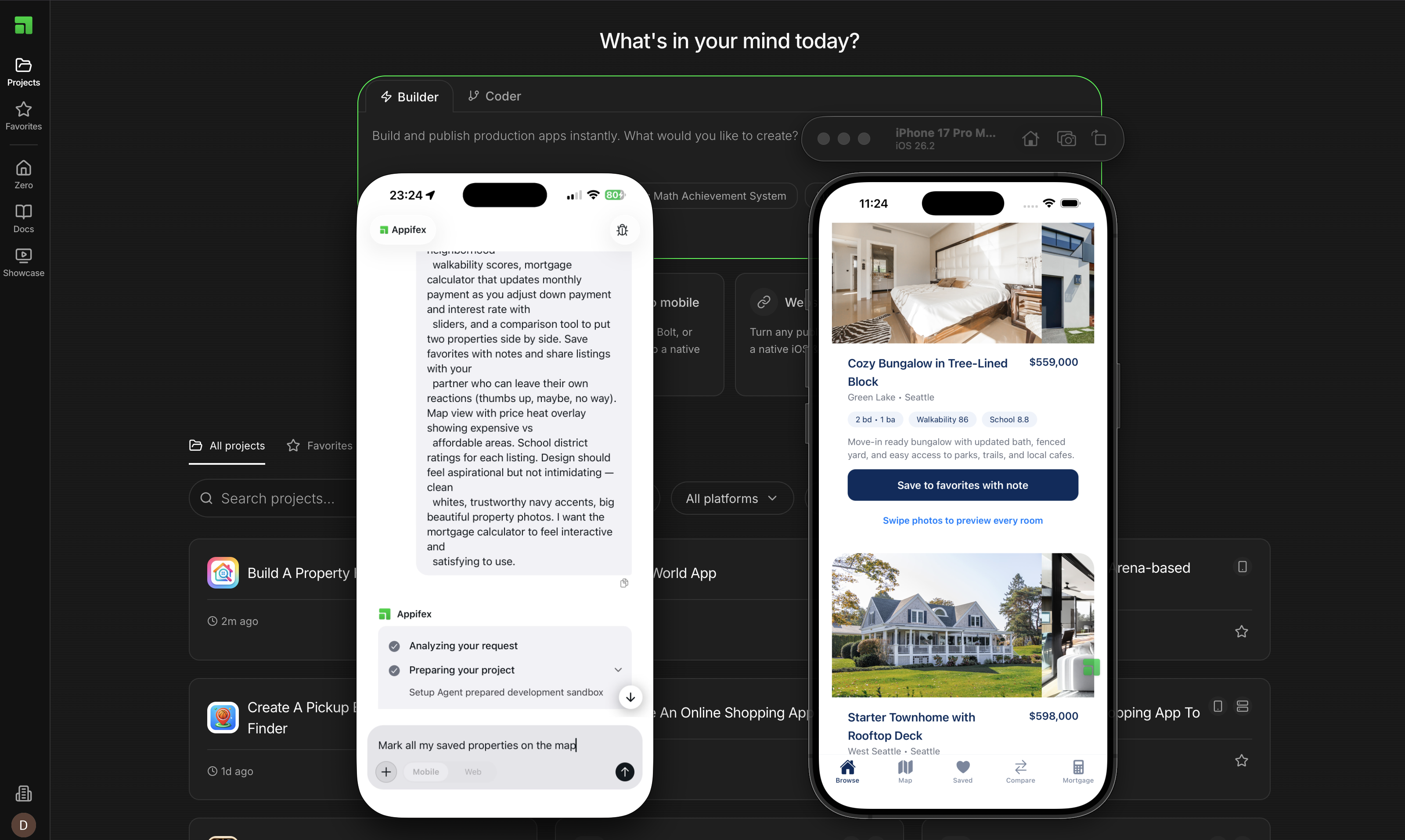
Ask any AI app builder to make you a web app and you'll have something deployed in minutes. Lovable, Base44, and the rest. They're all fast, and they all generate web apps.
Ask for a real mobile app and your options shrink fast. Either you get a PWA pretending to be native, or you're told to open Claude Code in your terminal, buy a Mac, install Xcode, set up provisioning profiles, and figure out Android and iOS builds yourself. One path gives you a website with an app icon. The other gives you a weekend of toolchain setup before you write a line of business logic.
We built Appifex to close that gap. Native code generation, on-device preview without Xcode or Android Studio, cloud builds for iOS and Android, and one-click publish to the App Store and Play Store. Describe what you want, click a few buttons, and you have a real native app on your phone, all from your couch.
Why mobile is technically hard
Deploying a web app means pushing a static bundle to a CDN. One command, done. Mobile has roughly ten times the surface area.
Native binaries need to be compiled separately for iOS and Android, signed with certificates that expire and rotate. OTA updates let you push changes without the store, but if the bundle doesn't match the binary, the app crashes. Testing means setting up Xcode and Android Studio or distributing a signed binary to a device. There's no localhost:3000 equivalent.
Then there's Apple and Google's review processes, each with their own metadata requirements and rejection criteria. One misconfigured field and you're blocked for days.
Most AI app builders skip all of this. We didn't.
A real React Native app, not a wrapped website
When Appifex generates a mobile app, the output is a real React Native app. Not a PWA. Not a WebView. A native app with smooth navigation transitions, gesture handling, and full access to device APIs: camera, haptics, location, secure storage, push notifications, biometrics.
Your generated app can use maps, play audio and video, run animations at 60fps, store data locally with SQLite, and integrate with Apple and Google sign-in. These are things a PWA simply cannot do, or does poorly. The gap between a website with an app icon and a native app is enormous, and users can feel it immediately.
The stack underneath is Expo and React Native, the same tools used by companies like Meta, Discord, and Shopify. Every package is from npm. The AI follows mobile-specific guardrails to ensure everything works together, so you get a polished native experience without worrying about compatibility.
Preview on a real device in seconds
This is where most "mobile" AI tools hit a wall. They can generate React Native code, but you have no way to see it on your phone without setting up Xcode or Android Studio.
After code generation and QA, Appifex publishes an over-the-air update. You scan a QR code with the Appifex companion app and your app loads natively on the device within seconds. No simulator. No build step. No Xcode.
Every time you iterate, the update goes straight to your phone. You see your changes on real hardware immediately.
Fullstack mobile from a single prompt
Most mobile apps need a backend. Appifex generates both a FastAPI backend and a React Native frontend in a single session, wired together automatically. The same code works in preview and production without changes. Both sides live in the same GitHub repo with the same git workflow as web.
From prompt to App Store
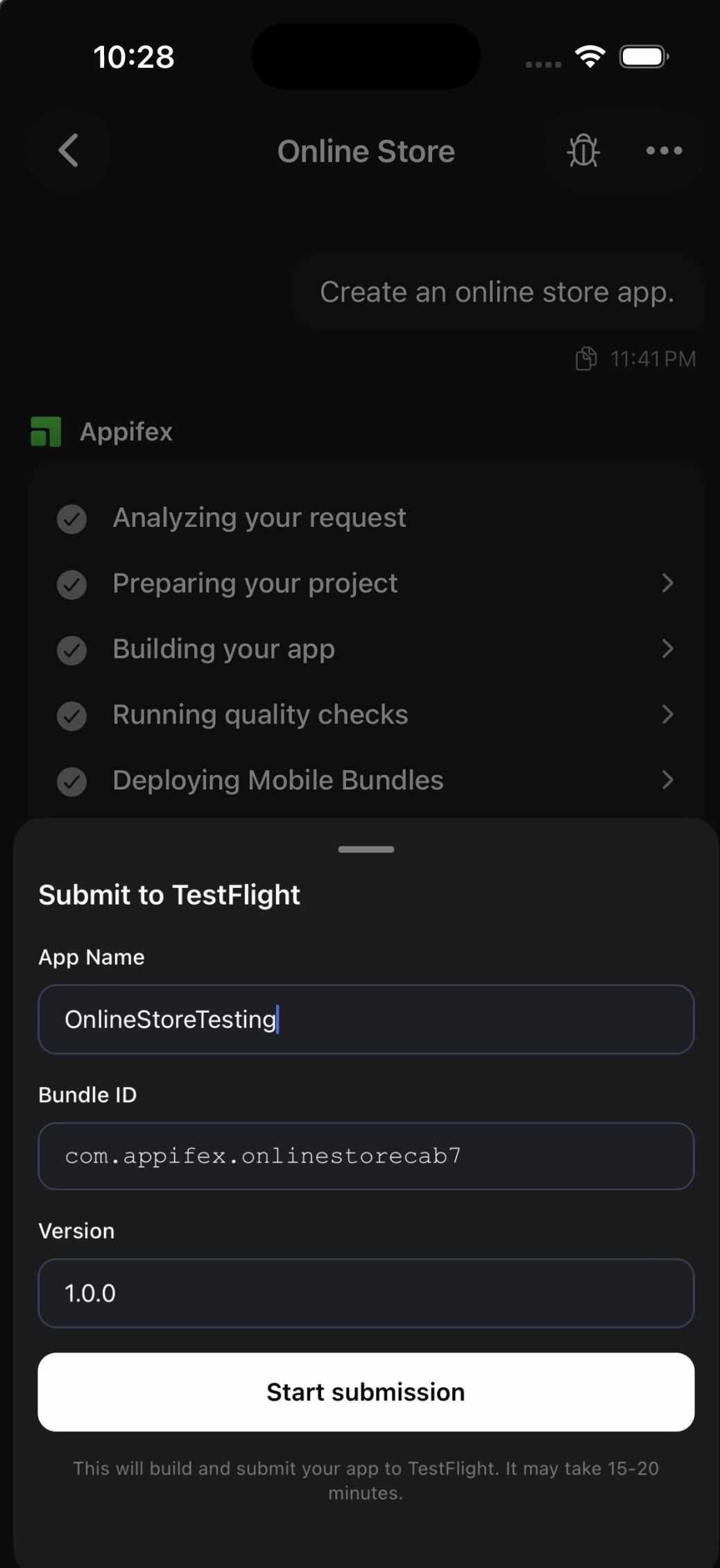
Getting a native app into the App Store and Play Store normally involves provisioning profiles, build signing, binary compilation, and store submission. Appifex handles all of it.
Connect your Apple/Google developer credentials, hit publish, and Appifex builds, signs, and submits in the cloud. The app is published under your name, to your store listing.
Your personal app store
When mobile apps are this easy to build, the use cases change. You're not just building the next startup MVP. You're building a reading tracker for your kids. A mini game for your commute. A shared grocery list that works exactly the way your family wants it to.
These are apps that would never justify hiring a developer, but they're genuinely useful to the people who'd use them. Appifex makes them possible because the entire pipeline from idea to app on your phone is a conversation and a QR code scan.
And if one of those personal projects turns out to be something other people want, the path to the App Store is a few clicks. Connect your Apple developer account, hit publish, and Appifex handles the rest (subject to Apple's review, of course). Wire up Stripe or RevenueCat for payments and you've gone from personal project to real product without rewriting anything.
Phones are where the users are
More than half of all internet traffic comes from mobile devices. Most consumer software gets used on a phone. But the current generation of AI app builders acts like the browser is the only deployment target that matters.
We built the full mobile pipeline because AI should be able to target the platform where most software actually gets used, whether that's an app for a million users or an app for your family.
And React Native is just the start.
Coming soon: SwiftUI and Apple Vision Pro
We're currently internal-testing SwiftUI support on Appifex. SwiftUI unlocks a tier of apps that React Native can't reach: visionOS experiences for Apple Vision Pro, SpriteKit and RealityKit games with native performance, watchOS complications, widgets that feel like part of the OS, and apps that take full advantage of Apple silicon.
Imagine describing a VR experience and having it running on your Vision Pro minutes later. Or building a 3D game with physics and particle effects, just by talking through what you want. That's what SwiftUI generation makes possible, and it's coming soon.
If you've been waiting for AI to catch up to mobile, it has. And it's about to go further.
For a step-by-step guide to publishing your app, see Apple's provisioning flow explained. To understand the QA pipeline that runs on every mobile build, read how our self-healing agents work. And to see the full architecture behind generated code, check out production-grade AI code. Ready to build? Start for free.