Claude Code can build your entire app. Good luck deploying it.
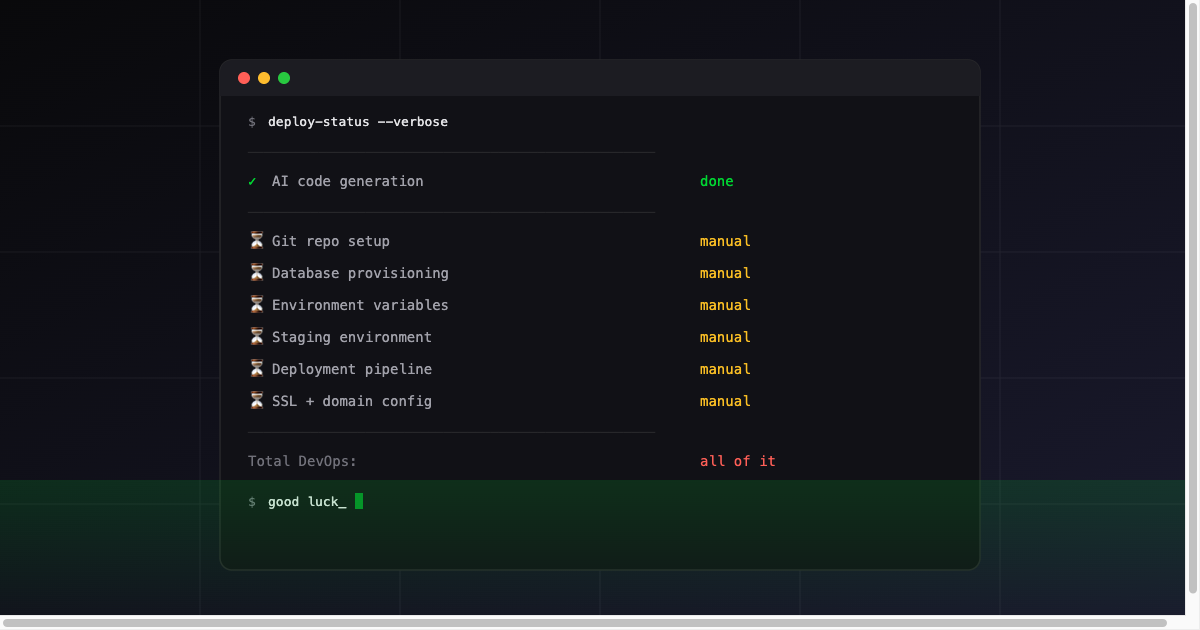
Claude Code, Cursor, Copilot. Pick your favorite. Any of them can generate a working app before your coffee gets cold. Then you spend the next three days setting up git, provisioning a database, wiring environment variables, configuring a staging environment, and figuring out deployment.
The generation problem is mostly solved. The infrastructure problem isn't. Browse r/vibecoding and you'll notice a second wave of complaints beyond code quality: everything that happens after generation. As one founder put it, "you end up spending a lot of time on devops and deployment stuff that isn't really building your product."
What "deploy it yourself" actually means
A generated app needs a git repo. A database with credentials injected into the right env vars. Dependencies installed in a real environment, not just passing a syntax check. Dev servers running on real ports. And when you want users: a hosting provider, domain config, schema migration from dev to staging to production.
Each step is two to four hours. They compound fast. A founder we talked to spent three weeks wiring auth and Stripe for an analytics tool. By the time the infrastructure was ready, he was too burned out to market it. The tool never launched.
The idea was fine. The setup killed it.
Prompt to live preview, one pipeline
Every Appifex project runs through a single pipeline from prompt to live app.
The classifier determines what you're building and picks the right scaffold. A cloud sandbox spins up. A Postgres database gets provisioned automatically via NeonDB, credentials injected. The AI generates on top of the scaffold, a QA pipeline catches errors, and you get a live preview URL you can open on your phone. Everything commits to a real GitHub repo with proper branching.
One prompt. No terminal, no config files, no "now go set up your database."
The sandbox is not a toy
Preview runs on E2B cloud sandboxes: actual microVMs with real file systems, real npm install, real pip install, real dev servers on real ports. Not a browser embed. Not a WebContainer simulating Node.
Close your laptop, come back tomorrow. The sandbox resumes where you left off. An eight-stage wake flow restores your code, reinstalls dependencies, restarts servers, and verifies everything is running. You click one button and you're back.
Sandboxes persist for 30 days. Keepalive runs during code generation so nothing times out. Between sessions, sandboxes pause automatically and wake on demand.
One-click publish
When you're ready for real users, the publish flow handles schema migration, deploys to the provider you choose (Vercel, Railway, Expo for mobile), and hands you live URLs. One modal, one button.
You bring your own accounts. Vercel handles both frontend and backend (via serverless functions) with a generous free tier. Railway and Fly.io give you persistent servers if you need them. Expo handles mobile builds and App Store submission. AWS and GCP support is in the works. You're deploying to infrastructure you control, not ours.
The order matters: you validated the idea and iterated on a live preview before touching production infrastructure. DevOps never blocked validation.
The generation gap
Claude Code and Cursor write code fast enough. The code quality problem has solutions. What's still missing is everything between generated code and a live app: sandbox, database, config, security, QA, third-party integrations, observability, preview, deploy, git.
That's the layer we built. Invisible until you need it, automatic when you do.
For the full picture of how the QA pipeline works, read self-healing agents that give your time back. To understand the code ownership model, see no vendor lock-in, no paywall. And if you need a mobile app too, check out how Appifex closes the mobile app gap. Start building for free.