AI App Builder Comparison: Why the Stack Doesn't Matter
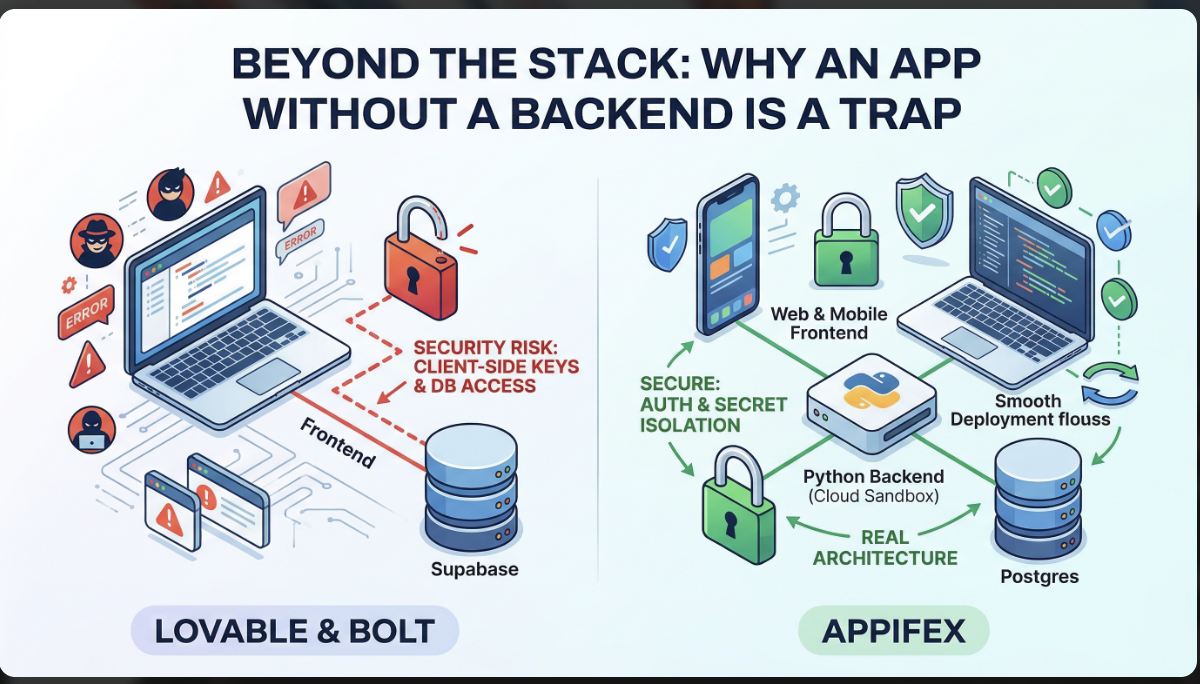
Someone asked me a question last week that I keep coming back to: "How do you differentiate beyond the technical stack?" And then, the harder follow-up: "Are you helping people build a robust dead idea, or helping them build the best idea?"
It's the best question anyone's asked me about Appifex. And he was right that I didn't have a good answer ready. So here's my attempt at one.
The convenience trap
Lovable and Bolt are fast. I've used both. For a landing page or a quick prototype, they get you to a working demo in minutes. No complaints there.
The problem shows up around week two. You find product-market fit, users start signing up, and you realize the codebase underneath is a convenience wrapper. The framework is proprietary. The database is managed by the platform. The deploy target is locked to their hosting. You can't hand the repo to a developer and say "keep going" because half the code is platform glue.
This isn't a hypothetical. Someone on Reddit built 30 hours on Base44 for a niche B2B tool they planned to charge $150/month for, then realized migrating means rebuilding from scratch. Someone else exported from Lovable to GitHub and immediately got stuck on deployment and backend setup. Another person burned through free trials on four or five platforms and found they all nail the todo app but fall apart the second you need conditional workflows or proper data relationships. The pattern repeats: the tool that was fastest on day one becomes the bottleneck on day thirty.
We covered the full lock-in story in a separate post. The short version: Appifex generates standard React, FastAPI, and React Native. Real GitHub repo from minute one. npm install && npm run dev for the frontend, pip install -r requirements.txt && python -m uvicorn app.main:app (or Poetry, or uv — your call) for the backend — it all works locally. Stop using us and nothing breaks.
Better infra isn't heavier infra
The pushback I got was fair: not every idea deserves enterprise infrastructure on day one. Most ideas won't survive first contact with users. Why build on a production stack when you're still figuring out if anyone cares?
Because the production stack isn't heavier. It's just better from the start.
At Google, even quick internal prototypes used the existing infrastructure. You didn't opt into Borg, Piper, and Tricorder. They were already there. A hackathon project got the same CI, the same code review, the same deploy pipeline as a production service. The infra didn't slow you down. It was invisible until you needed it, and when you did, it was already working.
That's the model. Appifex doesn't ask you to configure a QA pipeline or set up branch isolation. It's already there. You describe what you want, you see a working app. The six-stage QA pipeline ran. The git branch was created. The database was provisioned. The secrets are stored properly. You didn't have to think about any of it.
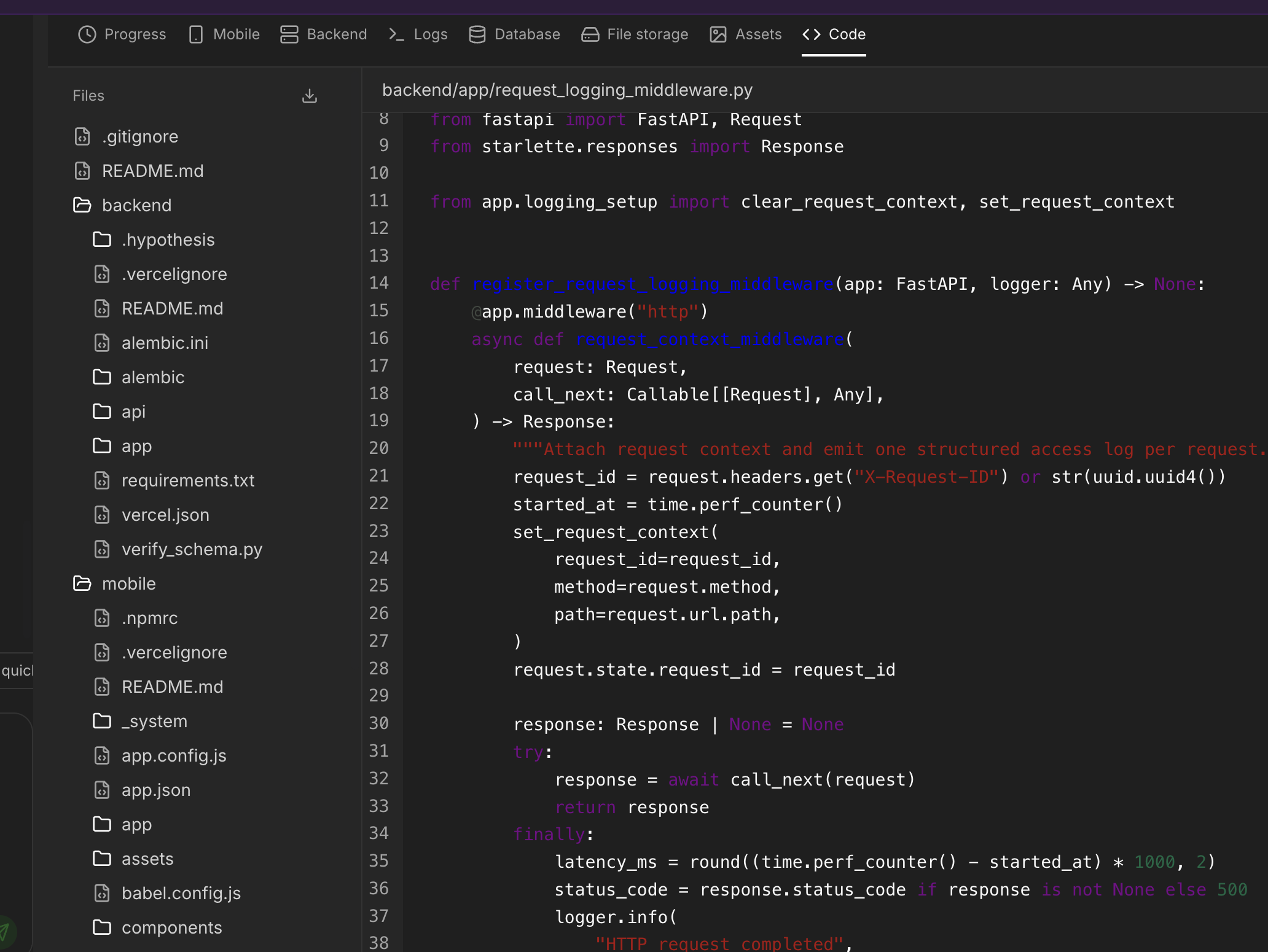
The experience is identical to Lovable or Bolt for a first-time builder. The difference is what's underneath, and what happens when you need it.
The thing most builders don't check
Open a Lovable or Bolt project in your browser's developer console. You'll see Supabase calls going directly from the frontend, API keys sitting in client-side JavaScript, auth decisions made by trusting a token the browser hands you. There's no server in between. One curious user opening DevTools can see your database structure, your keys, and potentially other users' data. A security researcher on Reddit audited dozens of AI-generated codebases and found the same pattern every time: the moment there's no backend, secrets leak, auth breaks, and payment webhooks can be faked.
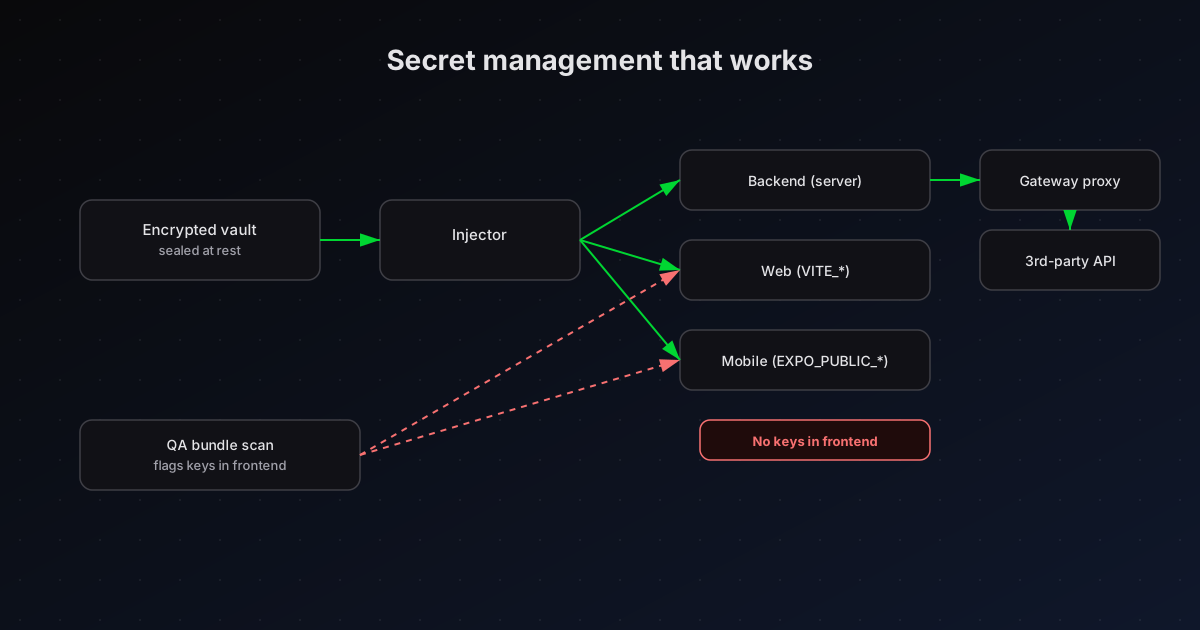
Appifex generates a real backend sitting between your frontend and your database. Environment variables are enforced per platform: only VITE_* vars reach the web frontend, only EXPO_PUBLIC_* reach mobile. Server secrets stay on the server. Auth uses database lookup, not client-side token trust. Third-party API calls route through a backend gateway so keys never touch the browser.
None of this makes the builder experience slower or more complex. You don't configure any of it. But when someone with bad intentions pokes at your app, the architecture holds up instead of handing them the keys.
One platform because stitching tools is where ideas go to die
The setup fatigue problem is real. We wrote about it in a dedicated post: a founder we talked to spent three weeks wiring auth and Stripe before his analytics tool even launched. By the time the infrastructure was ready, the motivation was gone.
Lovable handles web and a database in one place, which is fine until you need a mobile app or real backend logic. Then you're stitching in a separate mobile tool and a separate backend, each with its own account, billing, and paradigm. Your "simple app" now lives across multiple platforms that don't talk to each other.
A salon owner on Reddit wanted a booking app for her clients. A property manager needed to replace a sprawling Google Sheet tracking 100 buildings worth of access permissions, visitor logs, and banned lists across iPads. A marketing agency consolidated scattered client data from Sheets, Airtable, and email threads into one dashboard. None of these are complicated ideas. But each one needs a database, real backend logic, a web interface, and ideally a mobile app. The moment you outgrow what Lovable or Bolt can do in one place, you're stitching together additional tools to fill the gaps.
Appifex generates web, mobile, and backend from a single prompt. One codebase, one GitHub repo, one deploy flow. The frontend and backend are wired together automatically. The mobile app points at the same API. You iterate on all of it in one place.
This matters most for the person who's still figuring out their idea. The last thing they need is platform limitations standing between them and the answer to "does anyone want this?"
Builder mode and Coder mode
Everyone can be a startup founder before they even realize it. The builder who opens Appifex on their phone to make a fun app for their family is one good idea away from needing real engineering tools.
So we built two modes.
Builder mode is the default. It looks and feels like any other AI app builder. Describe what you want, see your app, iterate. GitHub is there but hidden, commits go straight to main with rollback if anything breaks. You don't see the QA pipeline, the database provisioning, the secret management. You just see a working app.
I built my mom a personal memory app for International Women's Day: our photos, my words, her reactions. Took ten minutes. She couldn't stop scrolling through it. My mom has never built anything with technology in her life. Then she opened Appifex on her phone and built one herself. AI isn't just for tech people. It's for your mom who wants to organize her recipes, your sister who wants a calorie tracking app, anyone who deserves technology that works for them. That's what Builder mode is. The production infrastructure is running, she just doesn't need to know about it.
Coder and Team mode is one toggle away. Now you see the GitHub repo, the branch per session, parallel branches so multiple people can work on different features simultaneously without stepping on each other. Background agents tied to GitHub issues. Slack notifications. Deploy to your own cloud accounts. PR reviews before merging to main.
The code is the same in both modes. The architecture is the same. The only difference is how much of it is visible to you. A non-technical founder can build in Builder mode for months and switch to Coder mode the day they hire their first engineer. Nothing to migrate, nothing to rebuild. The engineering foundation was there the whole time.
"Claude Code can do this too"
A founder I know who runs a unicorn with a deeply talented team in backend and distributed systems pushed back: "So does Claude Code." He's right. Claude Code can generate auth, payments, any integration. But each one is an hour or two of documentation reading, manual testing, and trial and error. Multiply that across auth, Stripe, file storage, email, and you've lost a week before your actual product logic starts.
Appifex has tuned skills for these integrations, tested tens of thousands of times across generated apps. The QA pipeline verifies they actually work in the sandbox before you see a result. When you deploy to production, you hook up your own accounts and the same code runs.
Even for a team like his, let Appifex handle the tedious baseline first. If you need more complex logic on top, pull the code and have your specialists build it locally with Claude Code or Cursor. Push it back. Two-way GitHub sync means you're not choosing between Appifex and your own engineers. You're letting each do what they're best at. Worried about non-technical teammates breaking things? Ask them to switch to Coder mode where every change goes to a branch. Review their PR before it hits main.
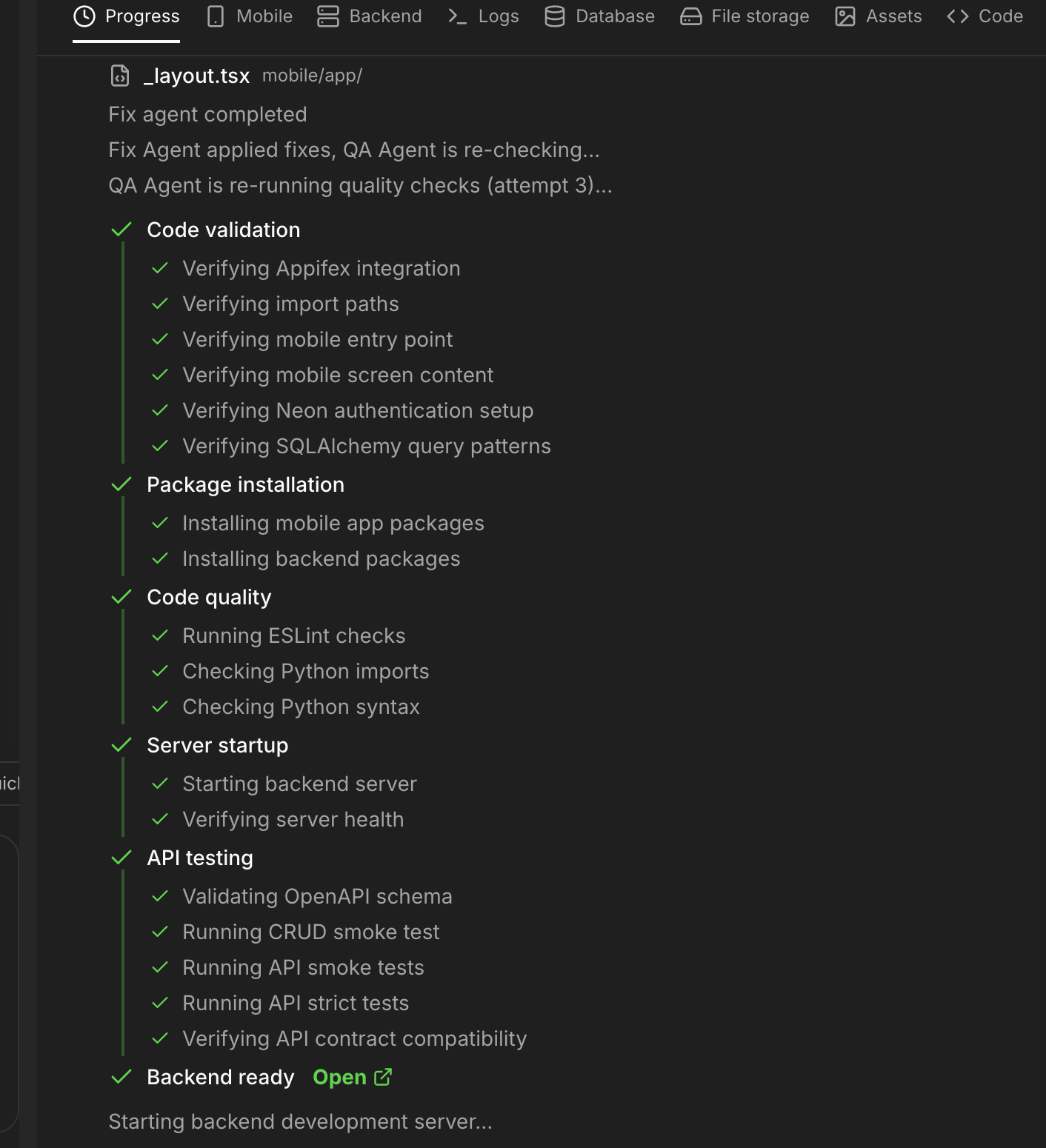
Every PR already has automated tests, a QA pipeline that verifies nothing is broken, and an isolated cloud sandbox with its own database branch where you can visualize changes before merging. Developers, be honest: how many of your current company's tech stacks have this kind of setup? Most teams I've worked at, including at Google, would kill for preview environments this easy.
Fewer builds to the right idea
The harder follow-up to that question was: "Are you helping people build a robust dead idea, or helping them build the best idea?" The world doesn't need 500 pomodoro timers. It needs the person with a good idea to spend their time figuring out if anyone actually wants it, not fighting deployment, lock-in, or exposed secrets.
Better infrastructure serves that goal. When you don't burn three days on deployment or a week migrating off a locked platform, that time goes to the thing that actually matters: talking to users, testing assumptions, pivoting when the data says to.
The stack genuinely doesn't matter. React or Vue, FastAPI or Express, PostgreSQL or MySQL. Pick any of them. What matters is whether you can keep moving when the idea lands. Whether a developer can pick up your code. Whether your users' data is safe. Whether your codebase rots under an agent without you noticing. Whether your app is still standing when users show up.
That's the infrastructure game. We're playing it so you don't have to.
And it's free.